

The phone call
For when ringing someone feels enormous.


A private rehearsal room for real conversation
Harbour lets you practice them out loud with a conversation partner. Then it shows you, with evidence from your own words and voice, how you actually showed up.
“The feedback was very accurate — and you can redo the skill as many times as you need.”
Supported by the University of Fribourg and Fri-Up · Built in Switzerland
The interview on Thursday. The call you keep putting off. The “can we talk?” that has been on your mind all week. If you replay conversations in your head and still come away unsure how they went, you are not alone.
Harbour is a rehearsal room, not a stage: private, patient, and free of judgment, with no audience and no score to perform for.
No scheduling, no waiting, no pressure. Practice when it suits you — whether that is 3 PM or 3 AM. Harbour is always available, always patient, and always judgment-free.
Select in the menu the situation that fits what you want to improve: job interviews, difficult discussions, everyday interactions.
A virtual conversation partner talks with you, adjusting to the situation you have chosen. Your conversation, short and realistic, feels like you were on the phone.
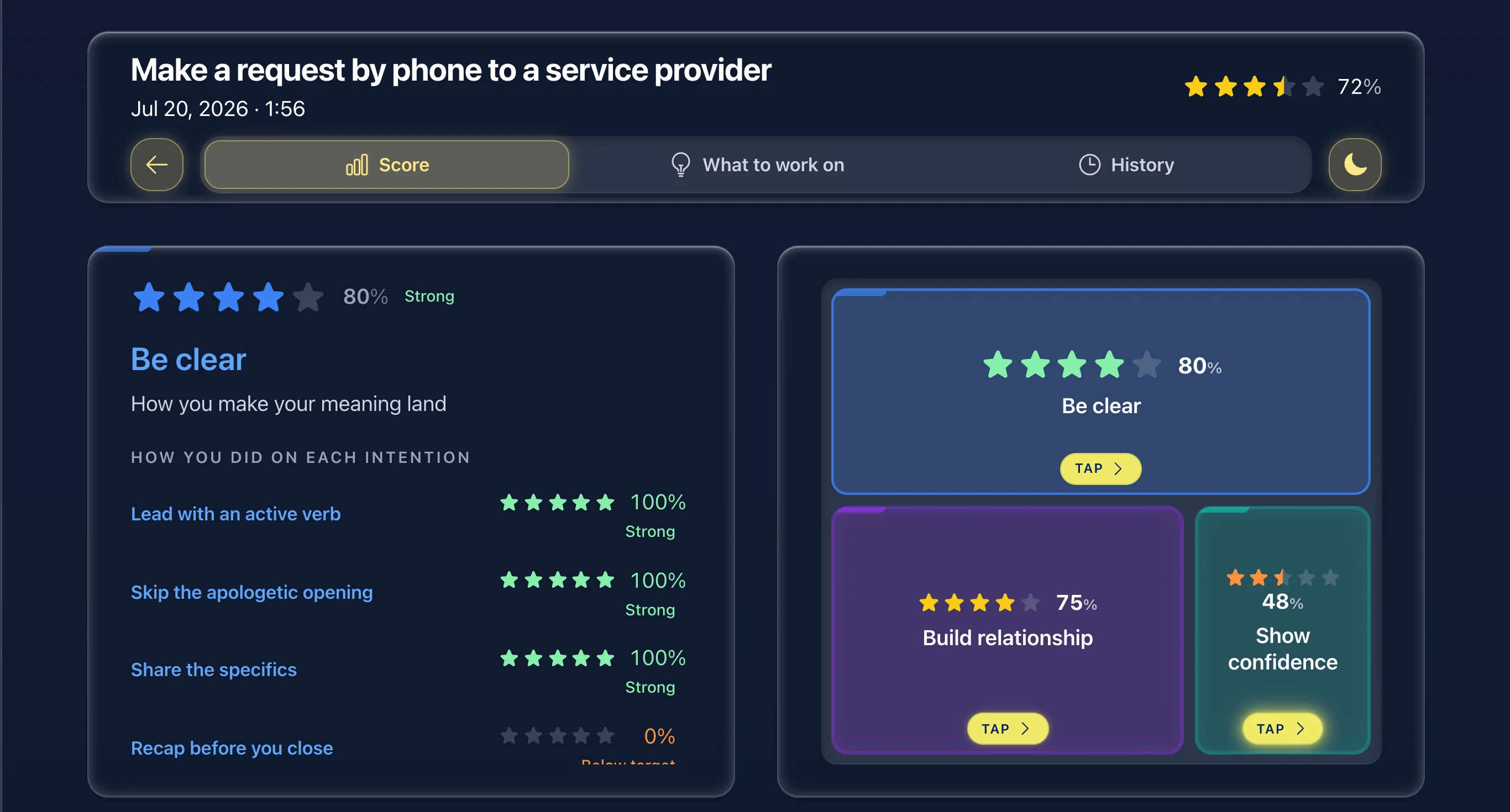
After each session, you receive clear and objective feedback based on scientific markers of effective communication. You also get practical suggestions you can use straight away.
Repeat to train further. Track your progress over time. See what changes. Build confidence session after session.
Artificial intelligence is used for the conversation partner voices, for transcribing the conversations, for spotting in each conversation the markers of a defined, scenario-specific analysis grid, and for the written synthesis of the results. The analysis grid and algorithms do not rely on artificial intelligence and are proprietary to Project Harbour.
No unexplained numbers. Every observation points at a moment you can recognize: a sentence you said, a pause you took, a question you asked.
Unlike communication tools that give generic feedback you cannot check, Harbour reads your conversation against a science-based analysis grid — not a general AI “judgement”.
Alex (AI partner)
Any chance you could take the Meridian file this week? I’m underwater.
You
I hear that the deadline’s heavy — and I can’t take it on this week. Could we look at Monday together?
Acknowledged first
“I hear that the deadline’s heavy” · 0:39 · you met them before you said no.
Clear refusal
“I can’t take it on this week” · 0:42 · no hedge, no false maybe.
Unhurried delivery
Steady pace and two deliberate pauses, with no rush to fill the silence.
A reconstructed example. Your report is built from your own session, with the same evidence-first structure across your words, your voice, and how the conversation moved.
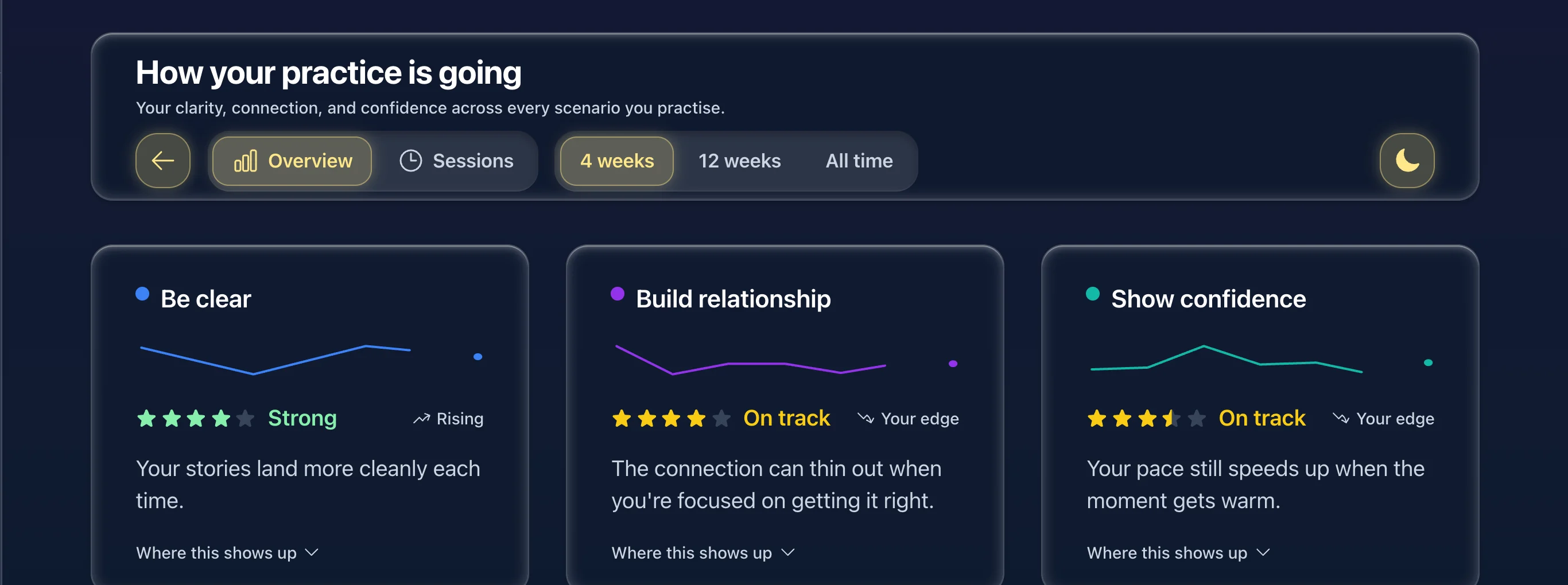
A growing library across social, professional, and health conversations. Pick the one you need.
For when ringing someone feels enormous.

Hold your story steady under questions.

Set a boundary and keep the relationship.

Let someone feel genuinely heard.

Lead with skilful questions.

Small talk without the script.
Every scenario is localized in English, French, and German, with personas that stay in character and analysis tuned to what the scenario is really asking of you.
Grounded in communication research
Supported and hosted by the University of Fribourg, Human-IST Department.

Chief Executive Officer & co-founder
Structures the project and turns the innovation into a product people want to use.
LinkedIn →
Chief Technology Officer & co-founder
Leads the scientific work and development of the tool.
LinkedIn →
Digital Product Designer
LinkedIn →
Tech Lead
LinkedIn →
Project & Quality Manager
LinkedIn →Expert advisers
Luciana Collomb (ASD special-needs educator), Dr Stephanie Durrleman (psycholinguist), Mathilde Gardin (psychotherapist), Fabrice Hiltbrunner (executive coach), Anne-Laure Musial (recruiter), Dr Olivier Simon (neurologist and physiatrist).
Art: Joel Ferrari, Aenigma. Development testing with Rafisa Informatik GmbH.
Contact
Questions, ideas, feedback? We would love to hear from you — hello@project-harbour.ch
Join the alpha: practice a real scenario, see your first mirror, and carry what you notice into the conversation that matters.